
Why Am I Gaining Weight After 35? Hormones, Metabolism & Hidden Causes Explained
Updated: Aug 6

Eating healthy and exercising, but still confused why that stubborn belly fat just won’t go away? It can be frustrating.
Many women wonder, 'Why am I gaining weight after 35, despite doing everything right?' What makes it even more confusing is that the same old routine and diet now seem ineffective. Your body is reacting differently, and weight gain may feel unexpected and difficult to control.
The reason lies deeper. Hormones and metabolism issues can be the answer to your questions.
Lifestyle Factors Contributing to Midlife Weight Gain
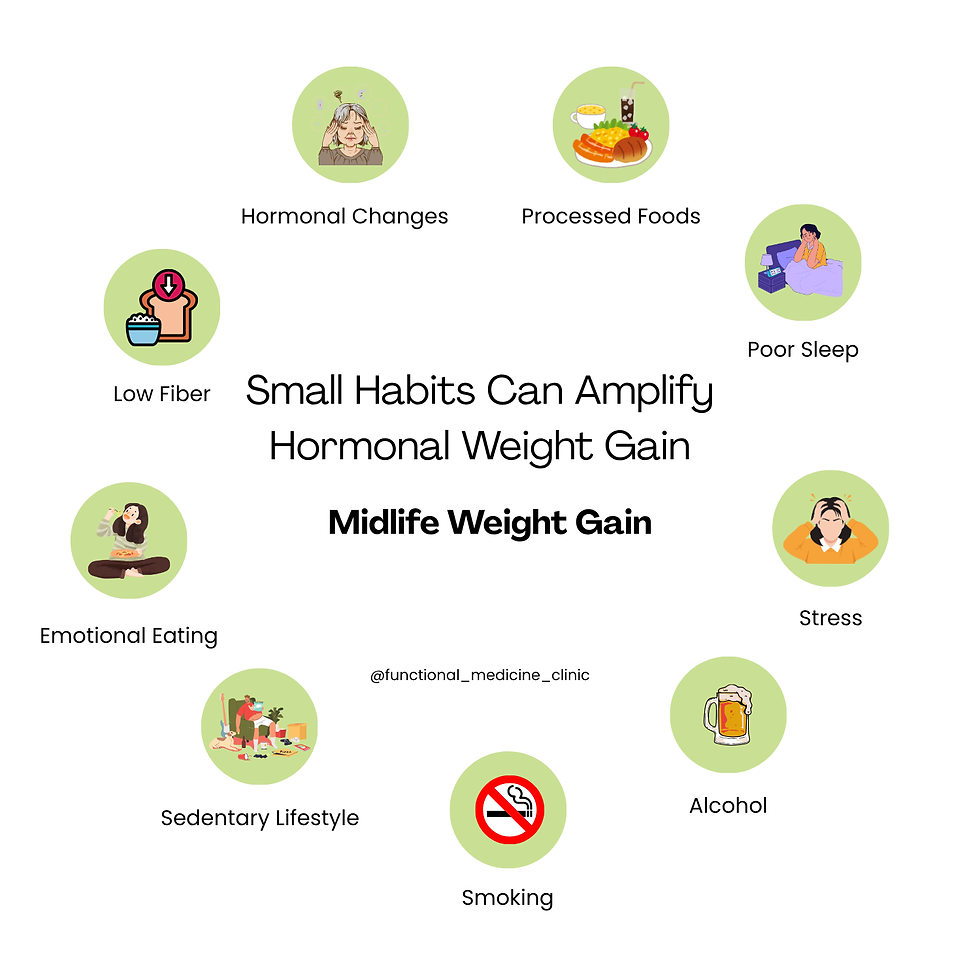
While hormonal changes play a significant role in midlife weight gain, everyday lifestyle habits often amplify the problem. After the age of 35, the body becomes more sensitive to these factors, making weight management more challenging even with the same routine.
Hormones – Hormones like estrogen, progesterone, thyroid, and stress hormones all play an important role in regulating metabolism
Processed Foods – High intake of processed food disrupts the body leading to weight gain
Alcohol Consumption – Excess alcohol alters fat metabolism in the body
Smoking – Excess smoking impacts our metabolic function and overall health
Low Fibre Intake- Reduces gut health and affects metabolism
Sedentary Lifestyle - Lack of physical activity reduces calorie burn and leads to weight gain
Poor Sleep Patterns – Poor sleep increases stress hormones and triggers hunger
Emotional Eating – Leads to increased calorie intake
Certain Medications- Medications can cause water retention in the body, increasing weight
Why Am I Gaining Weight Even Though I Eat Healthy?
You are not alone.
Eating healthy is a necessity. A balanced diet not only provides essential nutrients that support your health but also strengthens the immune system and helps the body fight infections. When the body's defence mechanisms are weakened, infections persist, leading to chronic inflammation.
Over time, this can disrupt metabolism and cause weight gain.
It's not just about calories. What you eat matters; adequate protein intake helps keep you full for longer, supports muscle mass and improves metabolism. Frequent sugar spikes from refined foods can disturb insulin balance, leading to increased fat storage. At the same time, gut health is also important for proper nutrient absorption and keeping inflammation in check.
Most women tend to stress eat. Chronic stress increases the hunger signals and cravings, often resulting in poor food choices and increased calorie intake.
Especially after 35, women experience a lot of hormonal issues. Some enter the perimenopausal phase, others struggle with thyroid issues, and many develop insulin resistance. Many start believing that weight gain is normal after a certain age, but it's actually the body's way of signalling that metabolism is changing and needs attention.
Types of Midlife Weight Gain Commonly Seen in Women After 35

Hormonal Weight Gain
Hormonal weight gain is mainly caused by imbalances in hormones. Hormones regulate appetite, fat storage, and metabolism. When they go out of sync, your body gets mixed signals.
You may notice:
Stubborn belly fat
Fatigue
Increased appetite
Mood changes
Difficulty falling asleep
Hormones such as leptin and ghrelin control hunger and satiety. Imbalance in these hormones can lead to increased cravings and overeating. Key hormones like estrogen and progesterone fluctuate with age, leading to fat accumulation. Along with these, cortisol, the stress hormone, becomes a perfect mix that can lead to an increase in weight and improper sleep. On the other hand, thyroid hormone, when it slows down, it slows down your metabolism too. It is not always about eating right, but balancing your body.
Timely medical evaluation, stress management, proper nutrition and good quality sleep can put your hormones on the right track.
Perimenopausal Weight Gain
The most misunderstood phase of a woman's life. Perimenopause is often under-recognised despite its significant metabolic and hormonal impact. Perimenopause is the transitional stage before menopause, seen in the late 30s to early 40s. Estrogen and progesterone fluctuate during this phase. Estrogen declines, and as it fluctuates, weight gain in the abdominal region becomes evident. Perimenopausal women usually experience a slower metabolic rate and reduced muscle mass.
Symptoms include :
Irregular menstrual cycles
Mood swings
Bloating
Fatigue
Reduced energy levels
These factors indirectly contribute to unhealthy eating and reduced physical activity, thus creating a vicious cycle of weight gain
Thyroid Weight Gain
The thyroid is our body’s metabolic engine. Thyroid hormones keep the brain, heart, and other organs working. It produces hormones such as T3 (triiodothyronine) and T4 (thyroxine) and helps our body in maintaining energy. In hypothyroidism, the thyroid gland is underactive, thus slowing down everything. Around 5 to 10 pounds of weight gain is seen gradually.
Accompanied by other symptoms such as:
Brain fog
Fatigue
Cold intolerance
Hair thinning
The BMR is decreased in patients with hypothyroidism, and most of the weight is due to excess water and salt retention. Once the thyroid levels are corrected, metabolism can improve, and weight loss becomes more achievable.
Insulin Resistance Weight Gain
Insulin is made by the pancreas; it helps your body use glucose for energy. When the cells do not use glucose effectively, a condition known as insulin resistance develops. Excess glucose is stored as fat, especially around the abdomen. In addition, excess belly fat worsens insulin resistance, leading to more weight gain.
Symptoms include:
Increased hunger
Cravings
Thirst
Frequent urination
Slow-healing wounds
Practical Tips to Manage Weight After 35

Yes, it is difficult but possible.
Build Muscle – As women age, loss of muscle mass takes place. Less muscle mass means fewer calories burnt. Strength training and lifting weights 2–3 times a week increases metabolism and increases lean muscle mass.
Prioritise Protein – Do not miss out on protein. It helps to keep your cravings away, balance sugar, and preserve muscle mass.
Focus On Sleep – Sleep well; lack of sleep increases hunger and cravings.
Move Your Body – Brisk walking, exposure to sunlight and stretching can help to regulate your hormones.
Say No to Sugar- Eliminate all forms of processed sugar and refined carbohydrates and you will be amazed at how your body responds.
Optimised Plan – A personalised plan made just for you, with the right diet and supplement recommendations, works better for your metabolism and helps you lose weight faster.
Wellness Providers – Working with healthcare providers for optimisation of your hormone profile can unlock better results.
Conclusion
Weight gain after 35 is often not just a result of diet or physical activity but a combination of hormonal changes, metabolic shifts, stress, sleep patterns, and lifestyle habits that influence it. As the body evolves with age, it requires a more personalised and mindful approach to maintain balance.
The goal is not just weight loss, but improving overall metabolic health—supporting your energy levels, mood, sleep, and long-term well-being. Small, consistent changes in nutrition, movement, stress management, and sleep can make a meaningful difference over time.
If you’re unsure where to begin or feel overwhelmed, seeking the right guidance can help you better understand your body and its needs.
We at Functional Medicine clinic focus on identifying root causes and designing personalised plans that truly work for your body.
Ready to take the next step? Book a free discovery call to begin your journey toward better health and sustainable weight management.

Frequently Asked Questions(FAQs)
Why is it harder to lose weight after 35?
After 35, there is a natural decline in metabolism due to factors such as lifestyle changes, thyroid imbalance, and hormonal fluctuations. Identifying and addressing the underlying causes can make weight management more effective and achievable.
Can high cortisol levels lead to belly fat?
Yes, high cortisol levels can lead to belly fat. Poor or inadequate sleep increases cortisol levels, keeping the body in a constant state of stress. Cortisol signals the body to store fat, especially in the abdominal region.
Why am I suddenly gaining weight in the stomach?
Weight gain in the stomach may be linked to metabolic changes, hormonal problems, increased stress, bloating, fluid retention and poor sleep patterns.
Can hormones cause weight gain?
Yes, hormones regulate metabolism, cravings and fat storage. When hormones are out of balance, they can change how the body stores and uses fat.
Does thyroid cause weight gain?
Yes, especially in hypothyroidism or underactive thyroid, the metabolism slows down, which can lead to weight gain. Some of this weight gain can also be due to water retention.
References
Jonklaas J. The influence of thyroid dysfunction on body composition and weight trajectory. Endocr Pract. 2026;32(3):406-415. https://doi.org/10.1016/j.eprac.2025.11.012.
Laurberg P, Knudsen N, Andersen S, Carlé A, Pedersen IB, Karmisholt J. Thyroid function and obesity. Eur Thyroid J. 2012;1(3):159-167. DOI: 10.1159/000342994
Cao J. How thyroid dysfunction contributes to weight gain and obesity-like phenotypes: a PubMed-based literature review (2015–2025). Theor Nat Sci. 2026;160(1):158-164. DOI:10.54254/2753-8818/2026.AU32359
Keller C, Larkey L, Distefano JK, Boehm-Smith E, Records K, Robillard A, Veres S, Al-Zadjali M, O’Brian AM. Perimenopausal obesity. J Womens Health (Larchmt). 2010;19(5):987-996. DOI: 10.1089/jwh.2009.1547
Singh B, Maurya NK. The cortisol connection: weight gain and stress hormones. Arch Pharm Pharm Sci. 2024;8(1). DOI:10.29328/journal.apps.1001050
Lund J, Lund C, Morville T, Clemmensen C. The unidentified hormonal defense against weight gain. PLoS Biol. 2020;18(2):e3000629. DOI: 10.1371/journal.pbio.3000629
Buscemi C, Randazzo C, Barile AM, Bo S, Ponzo V, Caldarella R, Malavazos AE, Caruso R, Colombrita P, Lombardo M, Buscemi S. Factors associated with body weight gain and insulin resistance: a longitudinal study. Nutr Diabetes. 2024;14:21. doi: 10.1038/s41387-024-00283-5
Everson SA, Goldberg DE, Helmrich SP, Lakka TA, Lynch JW, Kaplan GA, Salonen JT. Weight gain and the risk of developing insulin resistance syndrome. Diabetes Care. 1998;21(10):1637-1643. DOI: 10.2337/diacare.21.10.1637



Comments